Myanmar – a country frozen in time.
After we finished the adventure, I was on a high for weeks. My mind was full of the experiences, the images, the smells, food, the incredible sights we saw and the people we met on the way.
Bangkok airport. Our third attempt to locate our plane on the tarmac proved futile. The air in the shuttle was already steamy from the blistering sun, when it stopped again somewhere mid way to await further instructions as to where it should drop off the passengers. This was starting to look a tad embarrassing for the airport ground handling staff; I was just relieved that the bus didn’t spit us out in front of one of the planes with half an uncovered engine… our journey to Burma was a few hours delayed, which set us back a bit with our plans.
I have been intrigued by this country for a while now. In my mind I had a portrait of mystical palaces and temples dotting the skyline, Buddhist monks going on about their daily prayers, …. But that’s only the surface … as beautiful a place as it seems, this very insular country only just opened its door to tourists after its troubled past. Allegedly the events here inspired George Orwell to write his famous novel 1984. The plot is based on the dictatorship that took power of Myanmar after the British left in 1948, and is only just slowly fading away in this visually stunning country. A military junta kept 50 million of its citizens as hostages for almost 50 years and has managed to rob the country of almost everything – similarl to how Big Brother kept their citizens under their watchful eye.
I feel it is important to have awareness and blend travel with issues and not just go for holiday and fun. It doesn’t only go for Myanmar of course, but visiting here reminded me again and again that you have to look straight at both the beautiful and the ugly. Here I have to borrow a quote from Aung San Sui Kyi’s letters from Burma: “travelling with your eyes open, and looking for the dark as well as the light, is a guaranteed way of having an experience that lingers in your soul.”
Whilst some parts of the country are still no-go zones, you can travel throughout most of the south and central areas with no problems. The plan was to visit the main 4 areas – Mandalay, Bagan, Inle Lake and Yangon.
First observations – this country is quite literally littered with stupas, temples & pagodas …and stray dogs! Burmese people are generally quite short so suddenly I found myself rather tall amongst everyone – a new occurrence for me. And of course, the smell of Asia – mixture of frangipani and bougainvillea spilled over the fences.
We started with Mandalay – former capital of Burma, heavily bombed during the 2nd world war, and spread across the many hillsides and along the river, it offers so many sights to behold. We didn’t do it justice at all.
There is no shortage of sights to see in Mandalay and I know we didn’t do them all – a girl can only fit so many temples into her schedule!
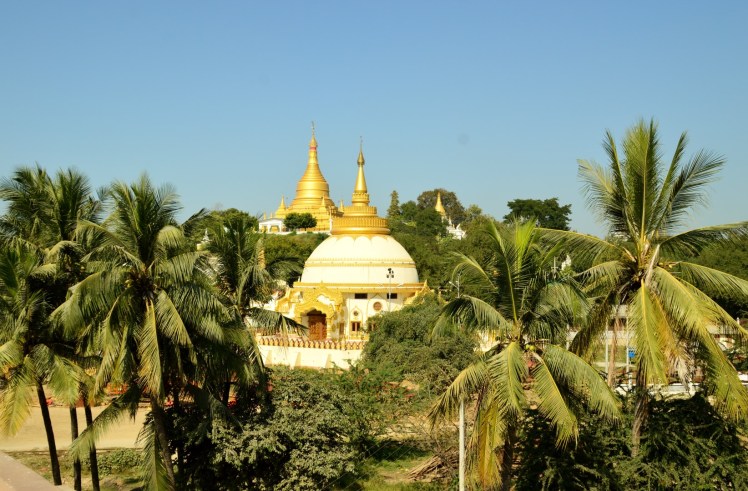
We had to rise pretty early to be able to see as much as possible. On our first day we visited some local pagodas, Mandalay Hill with its many temples towering over the city and the 3 ancient cities just outside of Mandalay – Amarapura – here is a famous Buddhist Monastery where more than a thousand monks live and study. We came to see the monk feeding ritual which was very touristy unfortunately. Then we visited the other cities – Sagaing and Inwa – the latter being my personal favourite. You can’t get there by a car, but a short ferry ride and a horse cart will transport you into a lovely countryside with picturesque ruins. For sunset we headed to see the world’s largest teak bridge, U Bein Bridge. It’s stunning, but whoever thought that setting up a car park for buses directly at the foot of it, and therefore ruining any photographic attempts, would be a good idea, clearly has no clue …
Although Mandalay is the second largest city of Myanmar, shockingly a large proportion of the roads here aren’t paved; some obviously are, but most of the time you’re driving on compressed dirt roads. This is something I’ve never encountered in a city of this size. After it gets dark, the streets completely dissolve into darkness and the air becomes smoky with wood fires. Portable restaurants consisting of almost ridiculously low plastic tables and chairs are popping up on every corner all over the city, selling deep-fried veg, nuts, variety of meats on sticks.
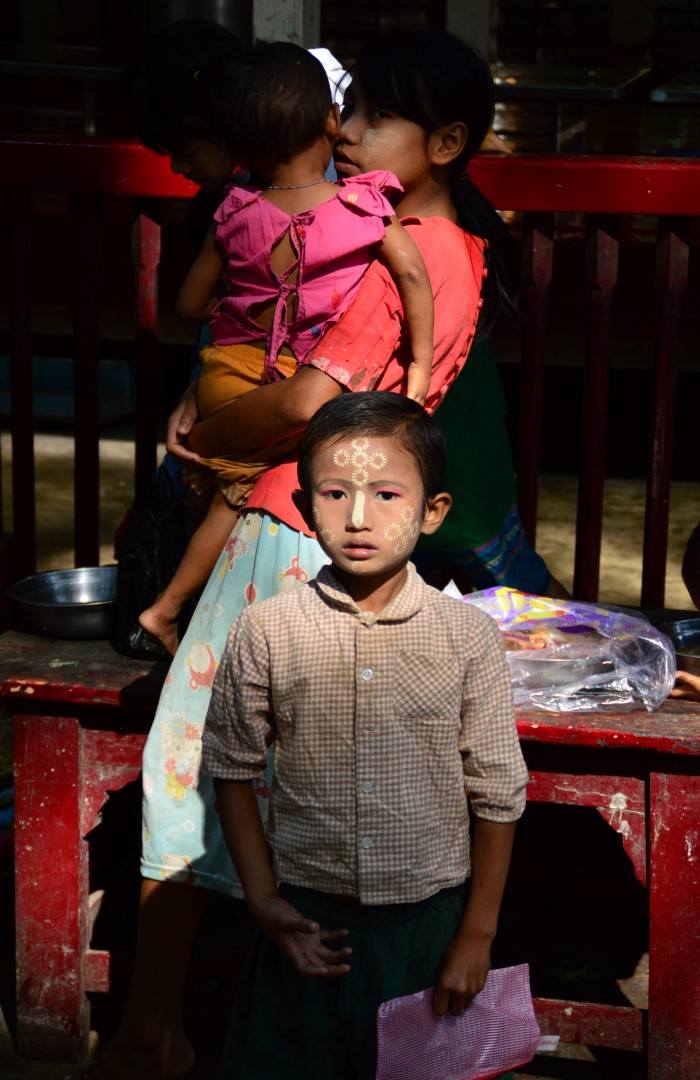
Street life & other observations:
-
There are lots of stray dogs wandering around the city, but most of them are friendly and only want to play.
-
The side of the road is a perfect place for any type of activity – like to get a morning shave, to play chess on the pavement. Little girls running from car to car and over-packed buses selling jasmine in the traffic jam.
-
Car honking might be a national sport (unconfirmed) … there’s a special honking language I think, hello – one short beep, watch out – sharp beep, overtaking – at least 2-3 beeps, long beep – thank you for letting me overtake you, happy beep – admiring girls
-
Children and women wearing multicoloured longyi, burmese traditional skirt, whilst building roads or working on constructions was a common sight.
-
Ladies carrying heavy baskets with elegance laden with produce to the brim, that a grown man would have problems with, walking barefoot no matter whether they are in the city or the countryside.
-
People are very friendly, always ready to help grinning through their betel-stained lips & teeth. Betel chewing and spitting leaving red stains on the floor …
-
Eccentric driving – Myanmar drivers used to drive on the left hand side under the British rule, but the country switched overnight to the right hand despite the majority of cars being right-hand drives. There are a number of theories as to why this happened, one being that General Ne Win — who was the Prime Minister at the time, had a bad dream about the direction so he ordered to change it the next day. The other theory is that the switch was based on an advice from his astrologer. Buddhism and astrology is very important in Myanmar.
-
You only need to know one word in Burmese to make people smile and relax – Mingalabar.
-
Buddhism plays a big part – possibly one of the most devout Buddhist nation. You will meet plenty of monks, they are very curious and want to get to know you. They often walk around with selfie sticks and will ask you to pose with them for a photo – Myanmar is catching up fast with the digital worls and wants to enjoy all the commodities of the modern world.
-
After the meal, typically you will be offered hardened jaggery – a sweetener made from sugar cane which is a traditional way to clean the pallet and a sign the meal is over. it’s quite nasty …
-
Women and girls swirl thanaka (Burmese cosmetic or sunblock made from tree bark) on their cheeks, and put fresh flowers in their hair.
-
Selfie and mobile obsessed country, mobile with sim card for $1
Bagan
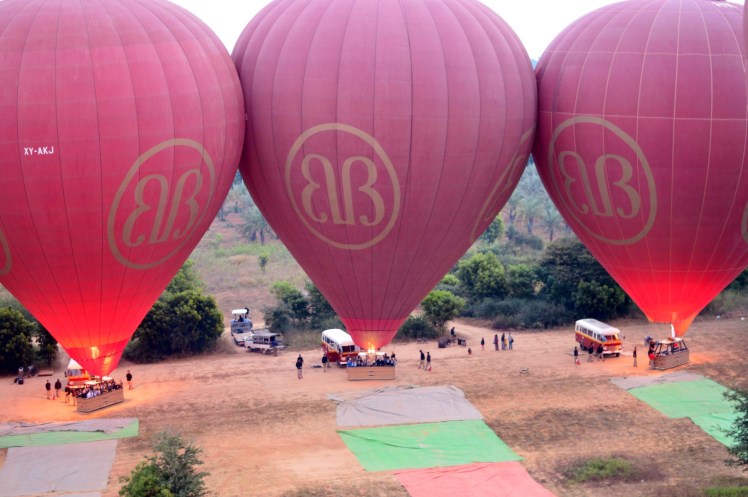
After we said goodbye to Mandalay, we boarded an early bus to Bagan. This ancient city is known for its more than 2000 Buddhist monuments surrounding the area. Aware of the vast size of the area, we decided to explore it from both the ground and above – we were going to take a hot air balloon ride over Bagan temples! Another early start – this is becoming a theme on this trip, there are no lie-ins – but this early wake up call was definitely worth it. We were promptly collected at 5am. After a thorough safety briefing, we were given some coffee and biscuits and watched how the crews began to set up the balloons. The flight started at dawn and took around 1 hour. Seeing all the temples below us was a numbingly beautiful sight. Slowly drifting in silence watching the light streaming through the clouds, we were admiring the views of the river and distant mountains waking up in early morning mist and observing rural life below us. Whilst it was not cheap, it was a wonderful experience like no other and it will remain easily one of the greatest memories of my life. After we landed, everyone received a balloon flight certificate, a glass of champagne and some pastries.
Fired up with excitement, we were ready to explore the temples from our bicycles. We made a mental map of all the remote temples whilst being adrift in the clouds, noting especially the ones that were a bit remote and away from the tourists. It was a fun afternoon getting lost and found between ancient temples, fields, bushes and shopping stalls. In Bagan we followed a recommendation for a vegetarian restaurant called The Moon and it didn’t disappoint with amazing selection of food and delicious fruit smoothies.
After visiting a few more temples in Old Bagan, we parked our bikes by one of the river side cafes with a happy hour. We concluded the last day of the year with a couple of margaritas and moorish salty cashew nuts whilst watching the sun go down. What a way to end the year …
1st Jan 2017 – starting the new year in a true traveller’s fashion – 5am wake up call and straight on the road for 10 hours to reach our next destination Inle Lake. On the way we stopped at Mt Popa and climbed to the sacred monastery perched atop of the extinct volcano. Not only do you have to watch out for the 37 Burmese spirits that reside here, but mainly beware of the little locals that will steal anything if you leave your belongings out of sight – cheeky monkeys!
Inle Lake
also known as Inle Sap. From Bagan it’s a long cross-country ride through some interesting and mountainous region. It’s famous for its floating villages and gardens (yes, floating gardens where the locals grow veg and flowers) and markets. People’s entire living evolves around the water, wooden houses are built on the stilts. The lake is set in a valley between mountains which provides for a very dramatic setting, the air is cooler which creates great conditions for growing wine too – yes, Myanmar has its own wine production. So of course we had to visit one of the wineries at the foot of the mountains called Red Mountain Estate vineyard. A lot of people rate the wine, but either we were incredibly unlucky or the wine is really quite awful. I shall not be bringing any back as a souvenir, Myanmar rum on the other hand is a totally different story – cheap and tasty!
We hired a private boat for the whole day to explore the lake. This was one of my most favourite days. The lake is really vast … We visited bustling markets, saw fishermen steer their one-man boats with a very unique rowing style where they wrap around one leg around the paddle. I loved a village called Indein – to get to it, your boat needs to navigate through river canals surrounding by some lovely rice fields. As we were riding through one of the canals, a woman wrapped in a traditional longyi knelt on a stone washing her hair with two huge buffaloes bathing next to her. I couldn’t quite figure out how she kept her cool, but clearly this is the daily river life occurrence. I thought to myself that every travelling moment is a privilege, allowing us to get a tiny glimpse of what other lives are like.
Once you get to Indein, there are two main areas of interest – the crumbling and atmospheric group of ancient pagodas immediately behind the village and then there’s a monastery with a long covered walkway – which by the way has probably the best stalls for shopping – which leads to an area literally packed with hundreds of stupas. Some are made of gold, some of bricks or clay. There’s so many of them, it’s like a bizarre maze, I don’t think I have ever seen anything like it.. We stayed in a small town called Nyaung Shwe and by far, this is where we tasted some of the best delicacies Shan state cuisine has to offer. Delicate curries and noodle dishes with fresh vegetables and oh those delicious sweet pineapple and chocolate pancakes! This was also the place we decided that some serious pampering was overdue and so we picked one of the places we passed on a few occasions that caught our eye – Aqua Lilies Spa. For a mere £10 we enjoyed 2 hours of utter and divine bliss so much that we went again the next day! 🙂
I could have stayed in Inle a few days longer, but it was time to move on again. We caught an overnight VIP bus to Yangon. The journey was quite gruelling, there is only one motorway (more like dual carriage way with no lights at all) in the country and it joins the city of Yangon with Mandalay. All other roads are mostly single lane only just wide enough for oncoming traffic. We could see some attempts at widening some roads, but improving the infrastructure in this country will be a very lengthy and challenging process. Our bus had to navigate a road through the mountain range in order to get to the one and only motorway in Myanmar. In places it was incredibly frightening, the bus was way too big for the road. The driver was pretty much in the first or second gear constantly slumming on breaks. In many instances we had to stop and the driver with his assistant had to pour cold water over the burning brakes – not a sight of calm in the middle of nowhere and in a middle of the night! Apart from the road conditions, the bus was very comfortable with almost reclining seats and the fare also included a light dinner at one of the rest places. After 8 hours, we got to Yangon safely.
Yangon
Rightly or wrongly, in my head I had a different image of this city. Sadly I found Yangon quite disappointing. Dilapidated colonial buildings, blocks of flats exposing mould are rotting away, yet most of the tiny flats have massive satellite dishes. The biggest attraction here is the shimmering Shwedagon pagoda complex. The entrance fee is also quite expensive by Burmese standards (£5). They do have ATM in the compound if you need extra cash. There are some colourful street markets and open-air food markets. Kandawgyi Lake is also worth a visit. Markets and street shops are full of stuff packed from the top to bottom – selling weird clothes, appliances, food and fruit, some artefacts are covered in dust. Stuff that I can’t even imagine would be sold in Europe.
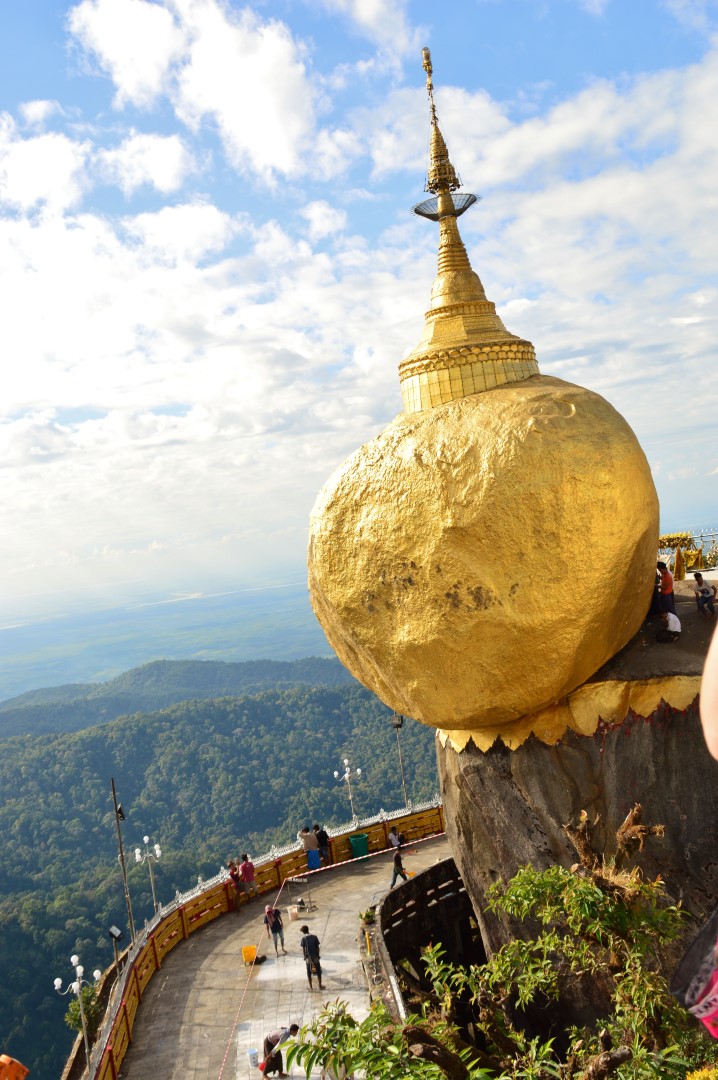
I couldn’t wait to leave Yangon so we arranged a trip to the Golden Rock pilgrimage site at Mt Kyaiktiyo. In hindsight I wish we stayed here overnight. The scenery is absolutely amazing … the huge golden rock is perched at the top balancing on the edge, sweeping views of endless mountains, lush jungle and winding river and, unless you are staying in one of the few small hotels, all tourists have to leave by 6pm so you’d have the whole mountain to yourself. It takes some 4 hours to reach the Golden Mountain from Yangon. At the bottom of the hill you board an open-top truck with other tourists. The journey to reach the top of the mountain is an adventure by itself – the truck is totally overcrowded and once the ride starts, you wish you made the choice to hike to the top instead. The mad drivers rush the truck so fast through an incredibly narrow windy road all the way up and again all the way down just as if you were on a roller-coaster. it’s a shame as the scenery is really beautiful and would be nice to savour it, instead you are holding for dear life.
Time to leave
Surprisingly Yangon’s airport is ultra modern and spacious. Carpets cover most floors, it almost has a 5 star hotel feel.
10 days have gone so fast.
We travelled entirely independently – poor infrastructure meant long transfers between places which tampered with our travel itinerary, timetables? what timetables…the occasional ATMs were out of cash and mobile / internet coverage makes it quite challenging. But those are minor annoyances, Burma is a magical place that will get under your skin. You will meet the kindest people, who have very little to live on yet are so eager to make sure you, as a foreigner, will have the best experience. The scenery is simply stunning to any photographer’s delight. Hope and expectations are lingering in the air, and I truly wish this country will finally have a fair chance at getting up on its feet. It’s not an easy place to visit – but it’s a place for those with a curious, open and adventurous mind.
 Eyes On The Cloud